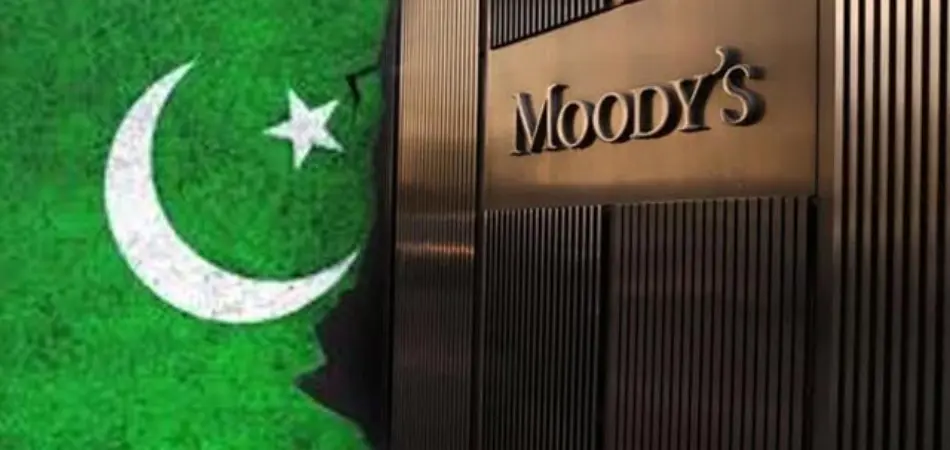
The global credit rating agency Moody’s has revised its outlook for Pakistan’s banking system. Previously “Positive,” the outlook is now “Stable.”
This change means Moody’s expects Pakistan’s banks to hold steady over the next 12-18 months, rather than show significant improvement. The agency cites a slow economic recovery, ongoing government debt issues, and continued risks in key sectors like agriculture as the main reasons.
Read More: State Bank of Pakistan Allows Mobilink Bank to Assess APNA Microfinance Bank for Potential Merger
Key Findings and Future Expectations
The report gives a balanced view of the sector’s health. Here are the main points:
| Strengths | Risks & Challenges |
|---|---|
| Strong capital reserves above requirements | Banks hold massive amounts of government debt (9x their equity) |
| Stable funding from customer deposits | Profitability is pressured by high taxes and lower interest margins |
| Problem loans are fully provisioned | Borrowers in vulnerable sectors (energy, agriculture) remain under stress |
| Government has a history of supporting banks | Government’s own fiscal limits cap how much support it can provide |
Moody’s expects banks to maintain solid performance thanks to projected credit growth and stable costs, but their fortunes remain closely tied to the government’s economic health.
The Bottom Line
While recent reforms have improved Pakistan’s economy, Moody’s believes the recovery is too slow and uneven for banks to thrive. The agency has also upgraded the long-term deposit ratings of five major banks—Allied Bank, Habib Bank, MCB, National Bank, and United Bank—reflecting the improved operating environment, but this positive step is now balanced by the more cautious system-wide outlook.