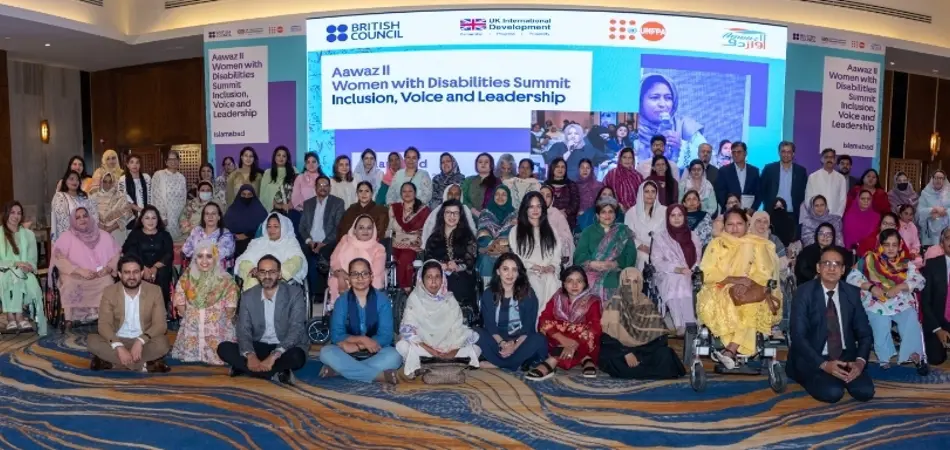
Pakistan held its first-ever National Summit of Women with Disabilities (WWDs) on June 29-30, bringing together women with disabilities from Islamabad, Khyber Pakhtunkhwa (KP), Punjab, and Sindh. The two-day Summit, themed “Advancing Voice, Leadership and Inclusion,” was convened by the Aawaz II Programme, funded by the United Kingdom’s Foreign, Commonwealth and Development Office (FCDO), with implementation by the British Council, UNFPA, and Care International.
Read More: Emirates clinches Best Airline Worldwide at the 2026 Business Traveller Middle East Awards
The Summit drew on three years of grassroots work under Aawaz II, which since 2020 has worked across 37 districts and established Special Interest Groups (SIGs) of WWDs in 15 districts of KP and Punjab beginning in 2024. These SIGs, comprising 247 members including 159 youth, provided safe spaces for women and girls with disabilities to identify the barriers they face and develop their own solutions. The national gathering built on provincial summits held earlier this year in Peshawar and Lahore, positioning women with disabilities not as beneficiaries but as leaders and rights holders.
| Summit Detail | Information |
|---|---|
| Event | First-Ever National Summit of Women with Disabilities |
| Dates | June 29-30, 2026 |
| Theme | “Advancing Voice, Leadership and Inclusion” |
| Convenor | Aawaz II Programme (FCDO-funded) |
| Implementing Partners | British Council, UNFPA, Care International |
| Participants | WWDs from Islamabad, KP, Punjab, Sindh |
| SIGs Established | 15 districts, 247 members (159 youth) |
Voices from the Summit
Officials and dignitaries who addressed the Summit included Mr. James Hampson, Country Director, British Council Pakistan; Dr. Yasmin Zaidi, Team Lead of Aawaz II; Dr. Gulnara Kadyrkulova, Deputy Representative of UNFPA Pakistan; Mr. Sam Waldock, Development Director at the British High Commission; and Ms. Zahida Qureshi, an Aawaz II Provincial Forum Punjab member.
“At the heart of the Charter is one powerful principle: ‘Nothing about us, without us’ – women with disabilities must not simply benefit from policies and programmes; they must help design them, shape them and hold institutions accountable for delivering them.”
— Mr. James Hampson, Country Director, British Council Pakistan
“You are all role models for women and girls with disabilities. You have brought change not only in your own lives but in the lives of thousands of other women with disabilities.”
— Dr. Yasmin Zaidi, Team Lead, Aawaz II
“WWDs face double discrimination – being women and being women with disabilities. Aawaz’s work has shown that when women with disabilities are provided with platforms, they not only identify their issues but also their solutions.”
— Mr. Sam Waldock, Development Director, British High Commission in Pakistan
Scale of Exclusion
Statistics presented during the Summit underscored the scale of exclusion facing persons with disabilities (PWDs) in Pakistan: only an estimated 0.3 percent of PWDs are registered with NADRA, and only 31% have ever attended school. Speakers noted that gender, disability, and poverty compound one another, leaving women with disabilities among the most invisible citizens in the country. Closing the Summit, Dr. Yasmin Zaidi noted that only around 230,000 women with disabilities are currently registered with NADRA.
Provincial Initiatives Highlighted
The Summit also included a panel of provincial government officials from Balochistan, KP, Punjab, and Sindh outlining current disability inclusion initiatives, including:
- Punjab Government’s Himmat Card programme
- KP’s distribution of more than 7,000 assistive devices and 2,000 electric wheelchairs
- Calls for the early passage of the Khyber Pakhtunkhwa Empowerment of Persons with Disabilities Bill
The National Charter of Demands
The Summit culminated in the presentation of a National Charter of Demands, the product of consultations beginning in December 2024 and carried through provincial summits in KP and Punjab. Grounded in the Constitution of Pakistan and the United Nations Convention on the Rights of Persons with Disabilities, the Charter calls on government, civil society, and society at large to act on five fronts:
“The time for action is now, so that no woman with a disability is left behind in Pakistan.”
— National Charter of Demands
A New Phase for Pakistan’s Disability Rights Movement
As the Aawaz II Programme draws to a close after years of work in KP and Punjab, organisers and participants described the Summit not as an ending but as the beginning of a new, WWDs-led phase of Pakistan’s disability rights movement, carried forward by the leadership, networks, and government linkages the programme leaves behind. Dr. Yasmin Zaidi affirmed that the National and Provincial Fora of Women with Disabilities, along with the SIGs networks established under Aawaz II, remain available to work alongside government departments to carry the Charter’s demands forward.
About Aawaz II Programme
Aawaz II is a programme funded by the United Kingdom’s Foreign, Commonwealth and Development Office (FCDO), working across 37 districts of KP and Punjab to amplify the voices of marginalized communities, including women and girls with disabilities. Its community component is implemented by the British Council, the public sector component by UNFPA, and the Sindh community component by Care International.
About the British Council
The British Council is the UK’s international organisation for cultural relations and educational opportunities, working in Pakistan to build connections, understanding, and trust between people in the UK and Pakistan.
About UNFPA
The United Nations Population Fund (UNFPA) is the UN’s sexual and reproductive health agency, committed to delivering a world where every pregnancy is wanted, every childbirth is safe, and every young person’s potential is fulfilled.
About the National Forum of Women with Disabilities
The National Forum of Women with Disabilities (NFWWD) is a platform representing women with disabilities across Pakistan, advocating for their rights, inclusion, and representation in policy and decision-making processes.