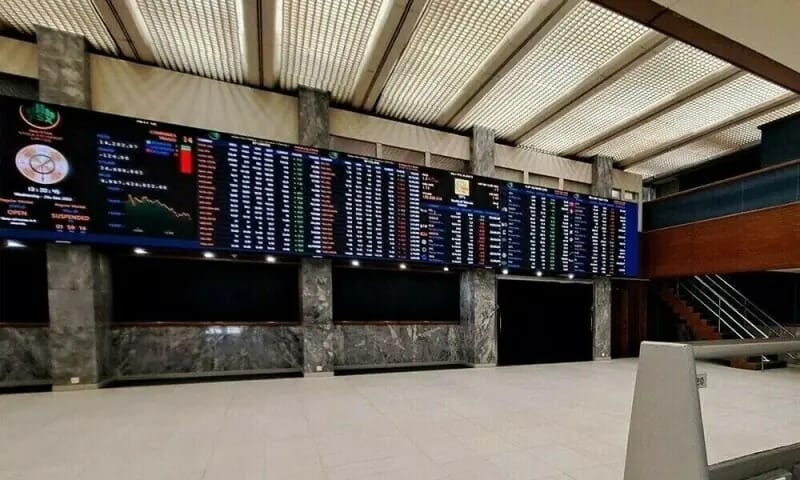
The Pakistan Stock Exchange (PSX) extended its losses on Tuesday as investor caution dominated trading, driven in part by lingering uncertainty around the privatisation of Pakistan International Airlines (PIA) and broader market sentiment. The benchmark KSE-100 Index declined further as traders adopted a risk-off stance, reducing exposure to equities amid concerns about near-term catalysts and economic headwinds.
Leading sectors including banking, energy, and industrial stocks recorded widespread pressure, reflecting a shift toward defensive positioning among investors. The trading session saw moderate volumes, with many market participants awaiting clarity on key developments such as the PIA privatisation process, macroeconomic policy signals, and external sector indicators before committing to fresh buys.
Market analysts noted that volatility in PIA-linked stocks — which have been sensitive to news flow and speculation around valuation, reference pricing, and bidder interest — contributed to the cautious tone. The prolonged uncertainty surrounding the national carrier’s privatization details has weighed on sentiment, prompting short-term profit taking and defensive rebalancing in portfolios.
In addition to PIA-related developments, traders pointed to mixed economic data and geopolitical concerns that have reinforced risk-aversion. As a result, the PSX’s downward pressure was broad-based rather than concentrated in specific sectors, indicating a general preference for capital preservation over aggressive positioning ahead of potential market triggers.
Despite the extended losses, certain pockets of the market showed selective buying interest, particularly in stocks with strong fundamentals and resilient earnings prospects. Analysts argue that while short-term volatility persists, long-term investors may view current price levels as opportunities to accumulate quality assets, provided economic reforms and corporate performance metrics improve.
Factors such as inflation trends, interest rate expectations, and external financing dynamics continue to be monitored by market participants, as these macroeconomic elements influence risk appetite and capital flows in Pakistan’s equity market. The intersection of these variables with corporate earnings outlooks will likely shape market direction in the coming weeks.
Overall, the PSX’s continued losses reflect a cautious trading environment as investors balance near-term uncertainty with longer-term opportunities. The market’s response to evolving developments — particularly around high-profile corporate and policy decisions — will be critical in determining whether sentiment stabilises or further consolidation emerges in the equity market.